
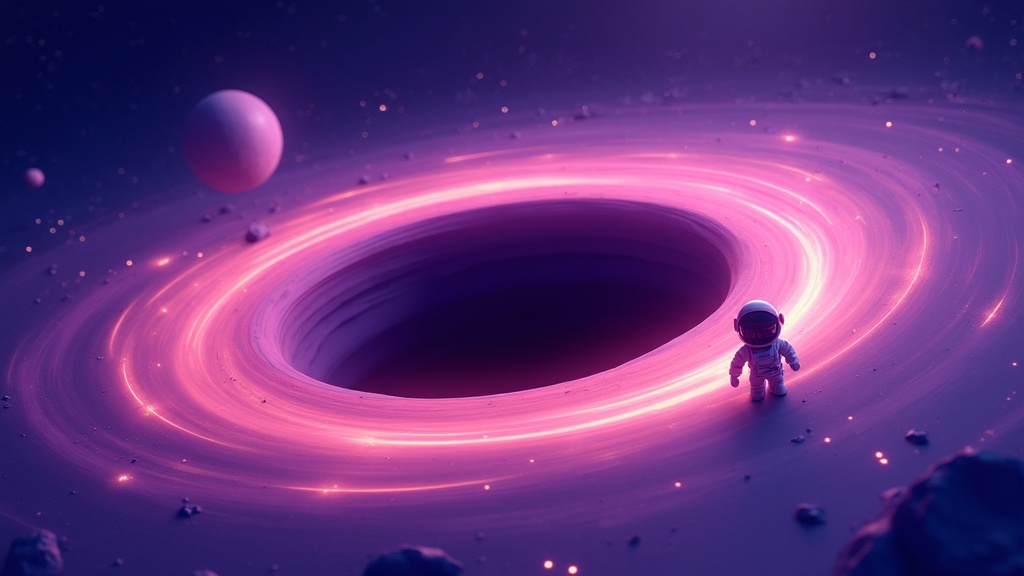
Imagine a place in space where the pull is SO strong that even light—the fastest thing in the whole universe—can't escape! Sound like science fiction? Nope, it’s the reality of a black hole!
Black holes are some of the strangest and most powerful things out there! A black hole is a region in space where gravity pulls so much that nothing, not even light, can get out. This super-strong gravity happens because a huge amount of 'stuff,' which scientists call mass, has been squeezed into a teeny-tiny space. This isn't a giant vacuum cleaner zooming around eating planets, but they are certainly fascinating for kids learning about space!

Mira says:
"I think the most amazing part is that they are totally invisible! If they don't let light escape, how can we *ever* find them? We have to become super space detectives and look at how they mess with the stars nearby!"
What is a Black Hole Anyway?
Think about throwing a ball up in the air. Gravity pulls it back down, right? A black hole has gravity that is cranked up to the absolute maximum setting! Because the gravity is so powerful, anything that gets too close gets pulled in and can never come back out.
A black hole doesn't have a solid surface like Earth or the Sun. Instead, it’s an area of space itself. The center of a black hole, where all that squished mass is, is called the singularity. Surrounding this center is a boundary line that is the point of no return. If you cross this line, *poof*, you're trapped forever! This boundary is called the event horizon.
Mind-Blowing Fact!
If you somehow fell into a black hole feet-first, the gravity pulling on your feet would be much stronger than the gravity pulling on your head! Scientists say this would stretch you out like a piece of spaghetti—a silly but true process called spaghettification!
How Many Kinds of Black Holes Are There?
Black holes come in different sizes, kind of like LEGO bricks! Scientists usually talk about three main types based on how much mass they have compared to our Sun.
Stellar Black Holes: These are the smaller ones. They are made when a giant, massive star runs out of fuel and collapses in on itself. This causes a massive explosion called a supernova, and if the leftover core is heavy enough, *poof*, a stellar black hole is born!
Supermassive Black Holes (SMBHs): These are the giants! They are the largest type, weighing in at millions or even billions of times the mass of our Sun! Scientists have found proof that nearly every large galaxy, including our own Milky Way, has a supermassive black hole right at its center.
Mass of the Milky Way's black hole (Sagittarius A*)
Minimum weight for a star to become a stellar black hole
Mass of the largest known black hole (TON 618)
Distance (in light-years) to the largest known black hole
How Did These Space Monsters Form?
The formation story for black holes is all about a star getting old and running out of fuel. It’s like a giant engine finally sputtering out!
For stellar black holes, the process is dramatic:
### The Supernova Story
1. Big Star Runs Out of Fuel: A star much, much bigger than our Sun burns through all its fuel over millions of years.
2. Gravity Wins: Without the outward push from burning fuel, the star's massive core collapses inward under its own gravity.
3. The Big Blast: This collapse triggers a massive explosion called a supernova, blasting the outer layers into space.
4. Black Hole Born: If the leftover center is heavy enough, it squishes down so small that its gravity becomes unbeatable, forming the black hole!
💡 Did You Know?
Even though they are black, scientists *can* find them! They look for stars orbiting what looks like empty space really fast, or they see super-hot gas swirling around them like water going down a drain, which gives off bright X-rays that telescopes can spot!
🎯 Quick Quiz!
What is the name of the boundary around a black hole that marks the point of no return?
Why Don't Black Holes Eat Everything?
This is a huge question for kids and parents! The biggest worry is: will a black hole eat Earth? The good news is no, Earth is safe!
Black holes don't just float around like cosmic vacuum cleaners sucking things up. They follow the same rules of gravity as stars and planets. If our Sun suddenly turned into a black hole of the exact same mass (don't worry, our Sun is too small to ever become one!), Earth would just keep orbiting it exactly like it does now.
- They don't wander: Black holes stay in one place unless something big pushes them.
- Distance matters: The Earth is currently very, very far away from any known black hole. The closest one is trillions of miles away!
- You have to get close: You only fall in if you cross that event horizon line. From far away, their gravity is just like any other massive object in space.
Scientists even have a term for the biggest one they've found so far: TON 618! It’s an ultramassive black hole with a mass of about 66 billion suns! That’s bigger than almost anything else we’ve measured. Keep listening to History's Not Boring for more amazing science facts!
Questions Kids Ask About Space & Science
Keep Looking Up, Explorers!
Black holes show us just how wild and wonderful our universe is! From exploding stars to invisible gravity traps, space is full of history-making science. Keep asking questions and exploring the cosmos, because history—even space history—is definitely NOT boring!