
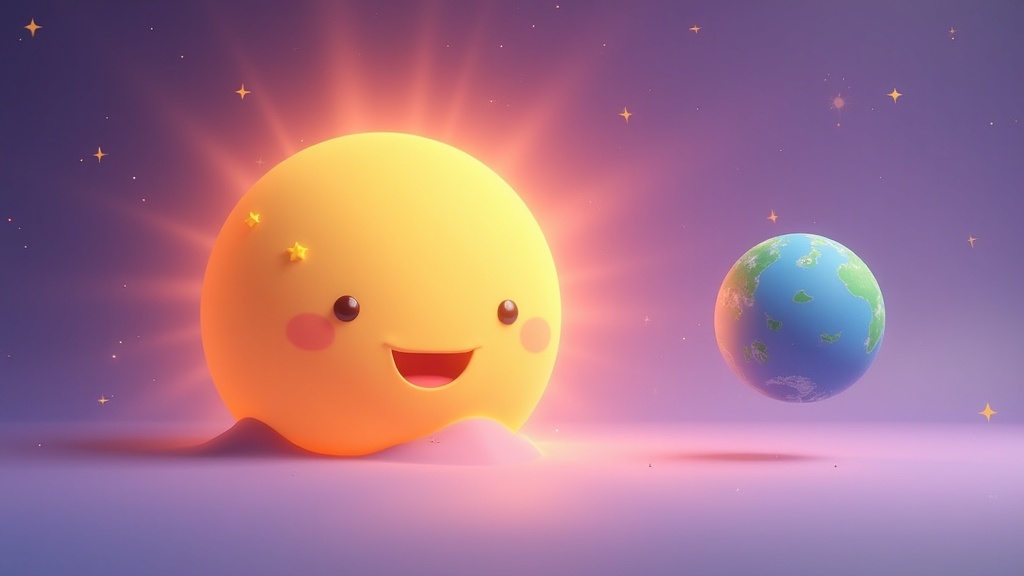
What if I told you the biggest, brightest, and hottest thing in our whole solar system is actually just an AVERAGE-sized star?
That’s right! We’re talking about the magnificent Sun! Every day, it gives us the light and heat we need to live, grow, and play. It’s so important that ancient cultures, like the Egyptians, even worshipped a Sun God named Ra! Though it looks calm from our window, the Sun is a massive, glowing ball of super-hot gas—mostly hydrogen and helium—and it’s been shining for about 4.5 billion years! It's the star at the very center of our solar system, and everything orbits around it, including our amazing home, Earth!

Mira says:
"The Sun is so far away—about 93 million miles! That’s 400 times farther than the Moon! But even from that distance, its light only takes about 8 minutes and 20 seconds to reach us. Talk about fast!"
What is the Sun Made Of?
Even though the Sun looks like a solid ball, it’s actually a huge, swirling mix of super-hot gases, kind of like a giant, fiery bubble! Unlike Earth, the Sun does not have a solid surface you could stand on. The main ingredients are two light gases: hydrogen (about 74%) and helium (about 24%). These gases are packed so tightly in the center that they create a never-ending, giant nuclear engine!
Mind-Blowing Fact!
Did you know? Even though the Sun is an average-sized star, it is SO big that you could fit more than one million Earths inside it!
How Hot is Our Star?
Get ready for some sizzling numbers! The Sun is incredibly hot because of the amazing process happening deep inside its core. This process, called nuclear fusion, is what makes the Sun shine and keeps it from collapsing under its own weight.
The heat generated in the core pushes outward, creating the energy that warms our planet. But the temperatures change dramatically as you move from the center to the outside!
(15 Million °C)
(6,000 °C)
(150 Million km)
How Does the Sun Make Light and Heat?
The secret to the Sun's power is hiding in its super-dense middle layer, called the core. This is where the magic of nuclear fusion happens!
It’s like a cosmic smash-up derby where hydrogen atoms are squeezed together with incredible force until they become helium atoms. This smashing releases HUGE amounts of energy in the form of light and heat!
The Journey of Sunlight
Once the energy is made in the core, it doesn't just pop straight out! It bounces around through a layer called the 'radiative zone' before reaching the 'convection zone,' where hot gas rises and cool gas sinks, like water boiling in a pot.
It can actually take over 170,000 years for that energy to travel from the core to the surface layer we see, the photosphere! Once it escapes the surface, it zooms across space to us in just over 8 minutes!
💡 Did You Know?
Did you know that the Sun has an atmosphere that is much hotter than its surface? The outer layer, called the corona, can reach over 3.6 million degrees Fahrenheit!
🎯 Quick Quiz!
What is the name of the process inside the Sun's core that creates all its energy?
Why Do We See Sunspots and Solar Flares?
The Sun isn't always perfectly smooth! Sometimes, cooler, darker spots appear on its surface called sunspots. These spots are cooler because they have super-twisted magnetic fields that slow down the heat coming up.
The Sun also has huge bursts of energy called solar flares and sometimes blasts of plasma called coronal mass ejections! These space weather events can sometimes mess with our radio signals on Earth, but they are an amazing show of the Sun's powerful energy!
- Sun Facts for Kids: The Sun is a yellow dwarf star, meaning it's in the middle of its life cycle.
- Age Check: Scientists think the Sun is about 4.5 billion years old and has about another 5 billion years left in this stage!
- Solar Cycle: The Sun goes through a cycle of being more or less active with sunspots every 11 years.
- Safety First: NEVER look directly at the Sun without special, certified solar glasses—it can seriously hurt your eyes!
Whether it's helping a tiny seed sprout into a giant sunflower or giving us the perfect sunny day for the playground, the Sun is the ultimate source of almost all energy on Earth. Keep looking up (safely!) and thinking about that incredible, shining star at the heart of our amazing solar system!
Questions Kids Ask About Space & Science
Keep Chasing the Light!
Wow, we learned so much about our closest star! From its super-hot core to the light that reaches us in just 8 minutes, the Sun is truly history’s most important star for life on Earth. What other space wonders should we explore next?