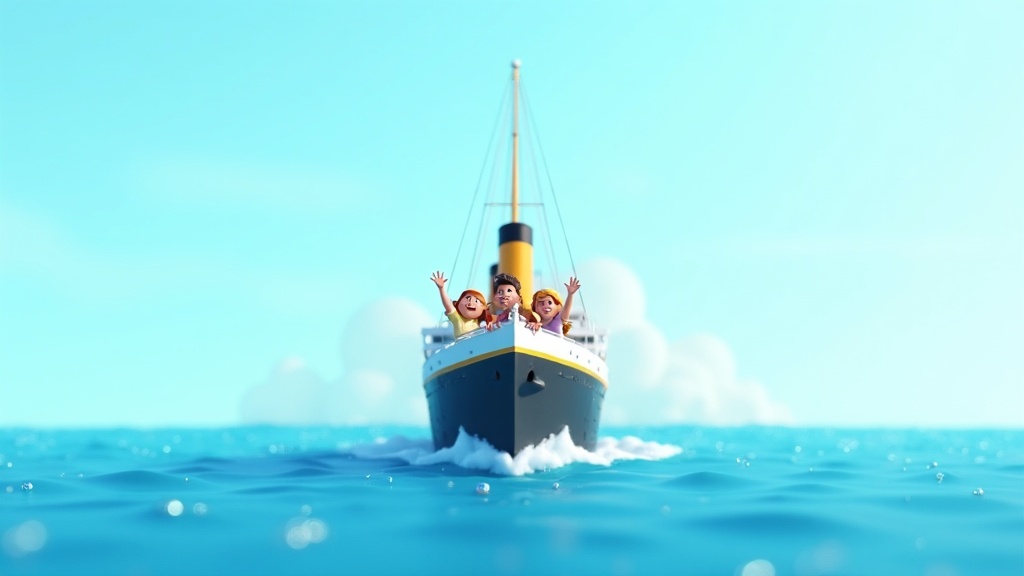
Imagine a ship so HUGE, so fancy, and so advanced that people actually called it the 'unsinkable' ship! Can you guess what we’re talking about?
We're diving deep into the amazing, but sad, story of the RMS Titanic! This giant British passenger liner was like a floating, luxury hotel sailing across the ocean. When it left port in April 1912, it was the largest moving object ever built! It was headed from Southampton, England, to New York City, America, filled with passengers from all over the world hoping for a new adventure. But just a few days into its trip, this giant of the sea met a fate no one expected. Get ready to learn the true story of the Titanic for kids, because history is *never* boring!

Mira says:
"Wow, Finn! It's wild to think that a ship that big could disappear under the waves. I bet the engineers thought they had solved *every* problem! It really shows us that even the best plans can change in an instant."
What Was the Titanic So Famous For?
The Titanic wasn't just any boat; it was the biggest and most luxurious ship sailing the seas when it was made! People thought it was the peak of technology. Think of it like the newest, coolest smartphone, but a giant ship you could live on!
It had ten decks, and the first-class areas were decorated like a fancy palace. First-class passengers could splash around in a saltwater swimming pool, play squash, and relax in a Turkish bath!
The ship also had four giant smokestacks (the big chimneys), but here’s a secret: only three of them actually worked! The fourth one was just for looks, to make the ship seem even bigger and more balanced.
Mind-Blowing Fact!
The Titanic's electrical system could make more power than an average city power station at that time!
Titanic by the Numbers: A Giant of the Sea
To understand how big this ship was, we need some big numbers! It was built in Belfast, Ireland, and it took over two years and 15,000 workers to finish the massive job.
This ship was so long that it was almost as long as three football fields lined up end-to-end!
Imagine how much fuel it needed! The furnaces that heated the ship and made the engines go burned over 600 tonnes of coal every single day! That’s like piling up 100 large elephants of coal daily!
(269 meters)
(53.3 meters)
(approx.)
(approx.)
How Did the 'Unsinkable' Ship Sink?
The Titanic left port on April 10, 1912, starting its exciting maiden voyage to America. Sadly, on the night of April 14th, after receiving warnings about ice, the ship kept going fast through the cold, dark water.
A lookout finally spotted a huge iceberg! The crew tried to turn the massive ship, but it was too late. Titanic hit the iceberg with a glancing blow.
The Watertight Compartment Problem
The Titanic was built with 16 watertight compartments—big sections sealed off by steel doors. The engineers thought that even if up to four of these sections flooded, the ship would stay afloat.
But when the iceberg scraped along the side, it didn't cause one big hole; it caused several smaller gashes that flooded six of the front compartments! Once too many compartments filled with water, the bow (the front of the ship) started sinking lower and lower, pulling the whole giant ship down with it.
💡 Did You Know?
It took the Titanic only 2 hours and 40 minutes to sink after hitting the iceberg on April 14th, going down in the early hours of April 15, 1912.
🎯 Quick Quiz!
How many lifeboats did the Titanic actually carry on its maiden voyage?
Why Does the Titanic Still Matter Today?
The sinking of the Titanic was a huge tragedy that shocked the world. It was one of the deadliest peacetime sea disasters ever.
Because so many people died, especially because there weren't enough lifeboats for everyone, the rules for ships changed forever! This disaster led to new laws called SOLAS (Safety of Life at Sea), making sure every ship *must* have enough lifeboats for everyone on board.
- The wreck of the Titanic was finally discovered on the sea floor in 1985 by explorer Robert Ballard.
- The freezing cold Atlantic water meant that survivors in the ocean died quickly from exposure if they weren't rescued fast.
- The ship's final distress signal was picked up by the Carpathia, which raced through the ice to save the survivors.
Even though the Titanic sank over a century ago, its story is still told in books and movies because it reminds us about human achievement, bravery, and the importance of listening to warnings. It’s a powerful piece of history for kids to learn about!
Questions Kids Ask About Famous Events
Keep Exploring the Depths of History!
The story of the Titanic is a true historical event that shows us the incredible highs and sudden lows of human innovation. From its luxury decks to the icy ocean floor, this ship made history! Ready for another amazing journey? Check out our other episodes about incredible moments in time!