
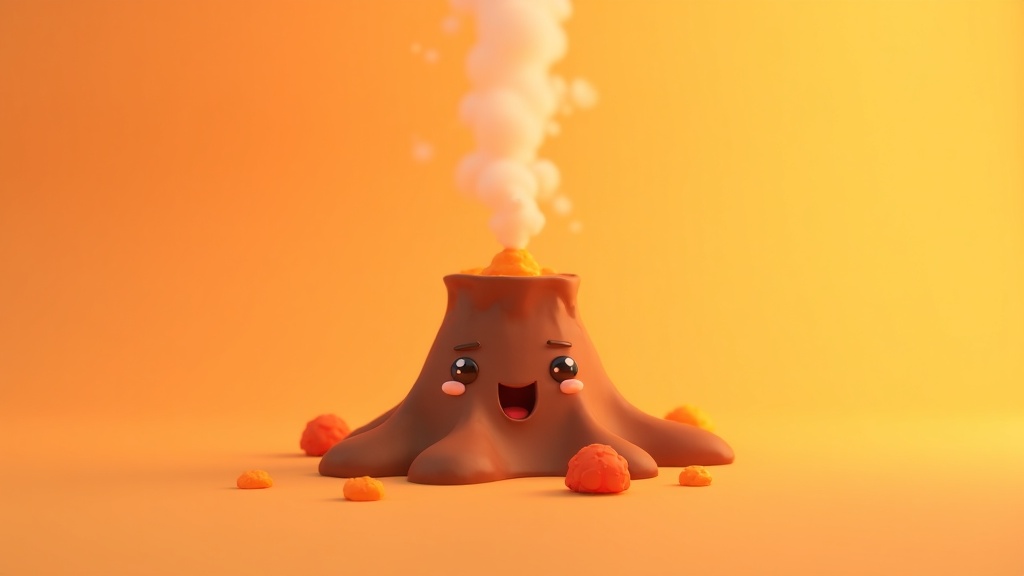
Have you ever seen a mountain that spits fire, hot rock, and smoke? Whoa!
That’s a VOLCANO! These incredible Earth features are like giant chimneys that connect the inside of our planet to the outside. The name 'volcano' actually comes from Vulcan, the Roman god of fire! Volcanoes are definitely powerful. They can build up new land and change the world around them in just one day. We will learn how these amazing, sometimes scary, mountains are formed for kids and explore some of the incredible eruptions that have shaped history, like the one that buried Pompeii in 79 CE!

Mira says:
"It's amazing to think that the Earth's crust is like a giant jigsaw puzzle made of plates that are always moving! Volcanoes pop up right where those pieces meet—it's Earth's way of letting off super-hot steam!"
What is a Volcano, Really?
At its simplest, a volcano is a mountain or opening in the Earth's surface. It opens down to a super-hot pool of melted rock underneath the ground. When the pressure builds up inside, *BOOM*! An eruption happens.
That hot, melted rock inside the Earth is called magma. When the magma finally bursts out through the opening (called a vent), it gets a new name: lava! Lava flows down the mountain sides, and the ash and rock shoot into the sky.
Repeated eruptions, where lava cools and hardens, are what build the volcano bigger and bigger over thousands of years!
Mind-Blowing Fact!
The tallest known volcano in our entire Solar System isn't even on Earth! It’s on Mars and it’s called Olympus Mons. It's about 17 miles tall—that’s way taller than Mount Everest!
Counting the Fiery Facts About Volcanoes
Did you know that scientists sort volcanoes into groups based on their shape? It all depends on how thick or runny the lava is when it comes out. Thicker lava stacks up tall and steep, while runnier lava flows far and wide.
The locations of most volcanoes are not random! They usually line up where the Earth’s huge puzzle pieces, called tectonic plates, meet up. A huge area around the Pacific Ocean is nicknamed the Ring of Fire because so many volcanoes are located there.
We know of on Earth!
in the Ring of Fire
Vesuvius's ash cloud in 79 AD
How Do Volcanoes Get Their Shapes?
The type of lava affects the volcano's look. Imagine pouring thick, sticky honey versus thin water—it makes a difference! Here are the main types you should know for kids:
Shield Volcanoes
These are built by lava that is thin and flows easily, like a runny syrup. This lava travels far before cooling, making the volcano wide and gently sloped, like a warrior's shield lying on the ground. Hawaii's Mauna Loa is a famous shield volcano!
Composite Volcanoes (or Stratovolcanoes)
These are the classic, cone-shaped mountains you often see in pictures! They are built up over time by alternating layers of thick lava, ash, and rock debris. They can grow to be super tall, like Mount Fuji in Japan.
Cinder Cones
These are the smallest type, made mostly of small pieces of hardened lava, called cinders, that are blown out of a single opening. They are steep but usually not much taller than 1,000 feet.
💡 Did You Know?
When an eruption happens under the ocean, the lava cools quickly into shapes that look like pillows—it’s called Pillow Lava! And sometimes, melted snow and ice mix with ash to create a super-fast, deadly mudflow called a lahar.
🎯 Quick Quiz!
What is the super-hot, melted rock called *before* it comes out of the volcano?
Why Do Volcanoes Erupt?
The main reason is pressure! Deep inside the Earth, magma has lots of gases trapped in it, like shaking a can of soda. As the magma rises toward the surface, the pressure drops, and those gases try to escape rapidly, pushing the magma out!
This can happen where plates are pulling apart, like in Iceland, or where one plate is diving under another. This second scenario creates the explosive volcanoes in the Ring of Fire.
- Active: Has erupted recently and might erupt again soon.
- Dormant: Hasn't erupted in a long time, but *could* erupt in the future (like a sleeping giant!).
- Extinct: Scientists think it has finished erupting forever.
One of the most famous, and tragic, events in volcano history was the eruption of Mount Vesuvius in 79 CE, which completely buried the Roman city of Pompeii. Eyewitness accounts from Pliny the Younger described the sky filling with ash and pumice stones raining down!
Questions Kids Ask About Earth Science
Keep Exploring Below the Surface!
Wow, volcanoes are certainly one of Earth’s most powerful and amazing features! They remind us that our planet is alive and constantly changing. Keep listening to History's Not Boring to discover more incredible science and history stories!